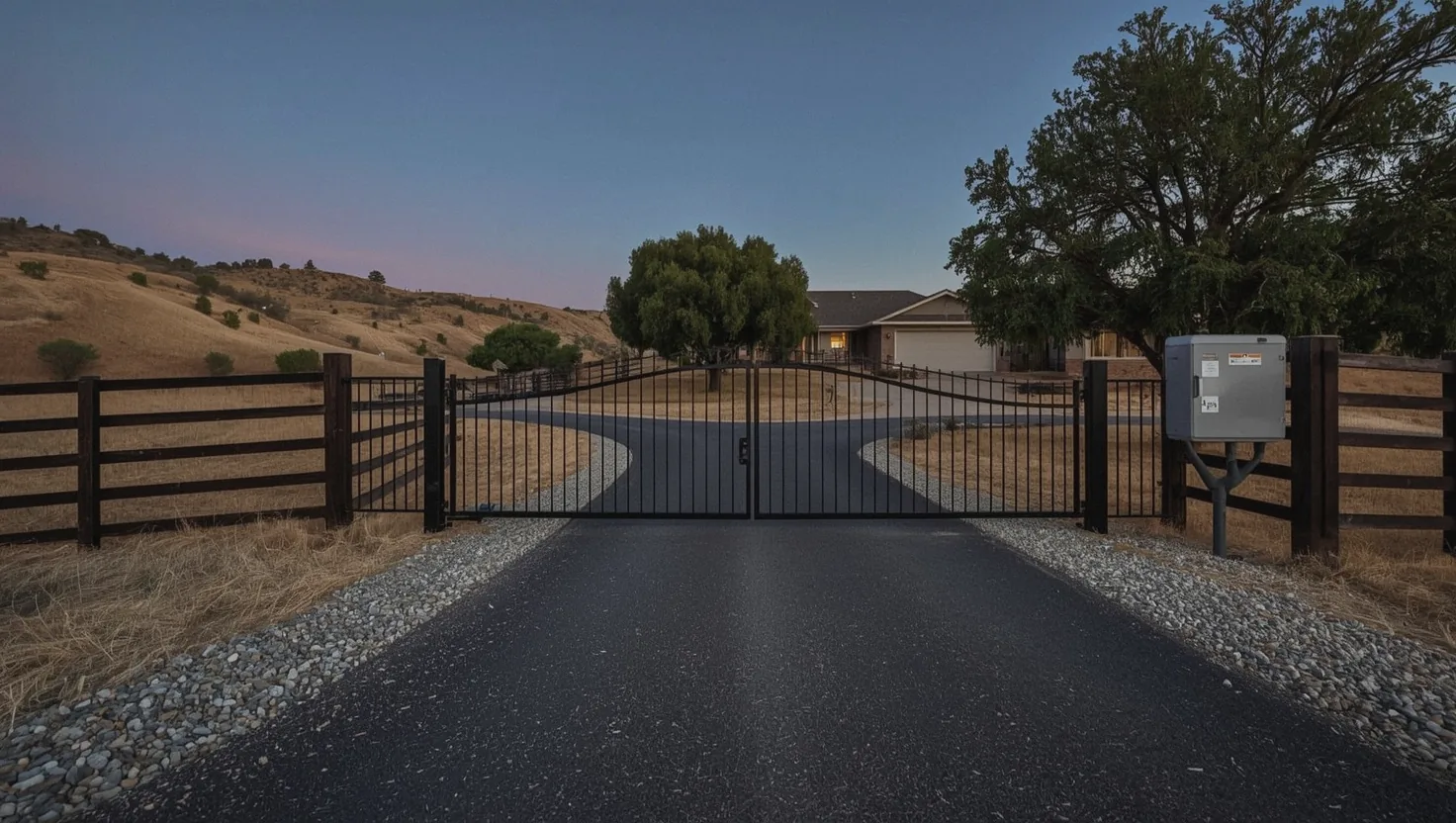
What Happens to Your Electric Gate During a PG&E Power Shutoff
PSPS season runs through autumn and rural Vacaville is inside the footprint. Here is what your gate will actually do when the power goes, and what decides whether it strands you.
PG&E shuts power off on purpose in this county, and it does it in exactly the places where automatic gates live. During a recent high wind event the utility warned more than 800 Solano County customers of a planned shutoff, naming areas west of Pleasants Valley Road near Vaca Valley Parkway, the Cherry Glen Road area west of Interstate 80, and land north and west of Rockville Hills Regional Park in Fairfield. Those are rural parcels with long driveways. Long driveways are where powered gates are.
So the question is not whether your gate will lose power at some point in the autumn. It is what the gate does when that happens, and that is decided long before the outage, by how it was set up.
Your gate does one of three things when the power goes
If it has battery backup, it keeps cycling normally for a period. How long depends on the battery, the weight of the gate and how often it runs, not on any number a brochure prints. A modest residential gate opening a handful of times a day will outlast one on a shared driveway that runs forty times.
If it has no backup, it stops where it is. That is the outcome people underestimate. The gate does not politely park itself open or closed, it simply stops responding, and whichever position it was in is the position you have until power returns or somebody uses the manual release.
If it is set to fail open, it releases and swings or rolls free so vehicles are never trapped. That is the right answer for some properties and completely wrong for others, which is the part worth thinking about before October rather than during it.
Fail open or fail secure is a decision, not a default
Every powered gate has a behaviour on power loss, and if nobody chose it deliberately then it is whatever the installer left set. The two options trade different risks against each other.
Fail secure keeps the property closed. Nothing gets in while the power is out, and you rely on battery backup and the manual release to get yourself in and out. This is usually right for a commercial yard, a storage site, or any property where an open perimeter overnight is the worse outcome.
Fail open releases the gate so it can be pushed clear. Vehicles are never trapped behind it and emergency access is unobstructed. On a rural residential parcel during fire season, in the kind of wind that triggers a shutoff in the first place, being able to leave without hunting for a release key matters more than the perimeter does.
Neither is universally correct. What is not acceptable is not knowing which one your gate is set to.
Everyone should be able to find the manual release
Every gate operator has a manual release. It disengages the motor so the gate can be moved by hand, and it works with no power at all, which is precisely the point. It is also the single most common thing a homeowner does not know how to use, because it was demonstrated once on handover day and never again.
Find yours now, while the lights are on. Learn where the key or lever is, learn where that key is kept, and make sure everybody who lives or works at the property knows both. A release key locked inside the house behind the gate you cannot open is a solved problem right up until it is not.
If you cannot find it or it will not budge, that is worth a call before the season rather than during an outage. Seized releases are common on gates near the marsh and the strait, where the mechanism has been sitting in salt air untouched for years.
Wind is doing two things at once
The weather that triggers a shutoff is the same weather that stresses the gate. PG&E calls these events when high wind, low humidity and dry fuel line up, often under a Red Flag Warning, and that wind loads a gate with solid or laser-cut infill like a sail on every cycle.
So autumn is when two failure modes arrive together: an operator already working harder than it was sized for, and the power supply it depends on going away. If your gate has been slow, hesitant, or reversing partway through its travel, that is the gate telling you something ahead of the season, and it is a much cheaper conversation in September than in the middle of a shutoff.
What to check before the season
Test the battery backup by cutting power at the breaker and cycling the gate. If it will not run, the battery has aged out, and batteries do age out quietly without any warning light.
Operate the manual release by hand and confirm the gate moves freely on its own. Stiffness here means a mechanical problem that the motor has been masking.
Obstruct the photo eyes and confirm the gate reverses. UL 325 requires at least two independent entrapment protection devices for each entrapment zone in each direction of travel, and the operator's own force sensing is only one of them.
Check the enclosure is sealed. Autumn brings the first real rain after months of dust, and moisture reaching a control board is the most common intermittent fault we chase in this county.
Related Services
Written by Vacaville Custom Metal & Electric Gates, who fabricate, install and repair gates across Vacaville and Solano County. Get in touch for a free on-site estimate.
Common Questions
Will my gate open during a PG&E power shutoff?
Only if it has working battery backup, or if you use the manual release. Without backup the gate stops where it is and stays there until power returns. Every operator has a manual release that works with no power at all, but it only helps if you know where it is and can reach it from the side you are on.
How long does gate battery backup last?
It depends on the battery's condition, the weight of the gate and how many times it cycles, so any single number would be misleading. What matters more is that batteries degrade silently over a few years and a backup that worked in its first season may not carry the gate in its fourth. Test it by cutting the breaker before shutoff season rather than finding out during one.
Should my gate fail open or fail secure?
It depends which outcome is worse at your property: an open perimeter overnight, or vehicles trapped behind a gate. Commercial yards usually choose fail secure with backup power and a manual release for staff. Rural residential parcels in fire-prone areas more often choose fail open, because the wind conditions that trigger a shutoff are the same ones that can require leaving quickly.
Can I add battery backup to an existing gate?
Usually yes. Most operators accept a backup battery, and where the existing unit does not, that is often a sign it is old enough that parts availability is becoming a problem anyway. We check the operator's condition and confirm its entrapment protection meets UL 325 at the same time.
Need a Gate Looked At?
Free on-site estimate anywhere in Vacaville and Solano County.
Get My Free Quoteor call (707) 471-6799